
Table of Contents
ToggleMid century modern design isn’t just a trend, it’s a proven approach to creating living spaces that feel both intentional and inviting. Born from the postwar design movement spanning roughly 1945 to 1969, this aesthetic prioritized clean lines, organic forms, and functional beauty. Wall decor from this era does more than fill empty space: it establishes visual rhythm and anchors a room’s character. Whether someone’s working with a pure mid century interior or blending elements into an eclectic home, the right wall pieces deliver impact without overwhelming the space.
Key Takeaways
- Mid century modern wall decor emphasizes clean lines, organic forms, and honest materials like teak, brass, and natural wood to create intentional, visually balanced spaces.
- Iconic pieces such as sunburst mirrors, abstract geometric prints, and sculptural wood panels define the style and work best when treated as focal points with adequate breathing room.
- Proper placement matters: hang art at 57–60 inches from the floor with 6–8 inches of clearance above furniture, and use gallery walls sparingly with consistent color palettes and structured layouts.
- DIY mid century wall decor projects like wood slat panels and geometric canvas art offer cost-effective ways to achieve the aesthetic while maintaining period-appropriate finishes.
- Authentic vintage pieces are available through estate sales and online marketplaces, but reproductions and licensed reissues provide quality alternatives that deliver genuine proportions without the vintage price tag.
What Defines Mid Century Modern Wall Decor?
Mid century modern wall decor follows specific design principles that distinguish it from other styles. Clean geometry dominates, think circles, starbursts, triangles, and asymmetrical compositions rather than ornate frames or busy patterns. Materials lean toward natural wood (teak, walnut, rosewood), metals like brass and chrome, and molded plastics that were cutting-edge in the 1950s and ’60s.
Color palettes tend to fall into two camps: warm earth tones (burnt orange, mustard yellow, avocado green, harvest gold) or cooler, sophisticated neutrals punctuated by bold accent colors. The aesthetic avoids fussy details, no elaborate carvings, gilded frames, or Victorian flourishes. Instead, pieces emphasize form following function and celebrate materials in their honest state.
Authentic mid century wall art often features abstract expressionism, atomic-era motifs (sputnik shapes, atomic starbursts), or stylized natural forms. Sculptural elements might include carved wood relief panels, metal wall sculptures with kinetic elements, or ceramic tile arrangements. The overall effect should feel curated and deliberate, not cluttered.
Iconic Mid Century Modern Wall Decor Pieces to Consider
Abstract Art and Geometric Prints
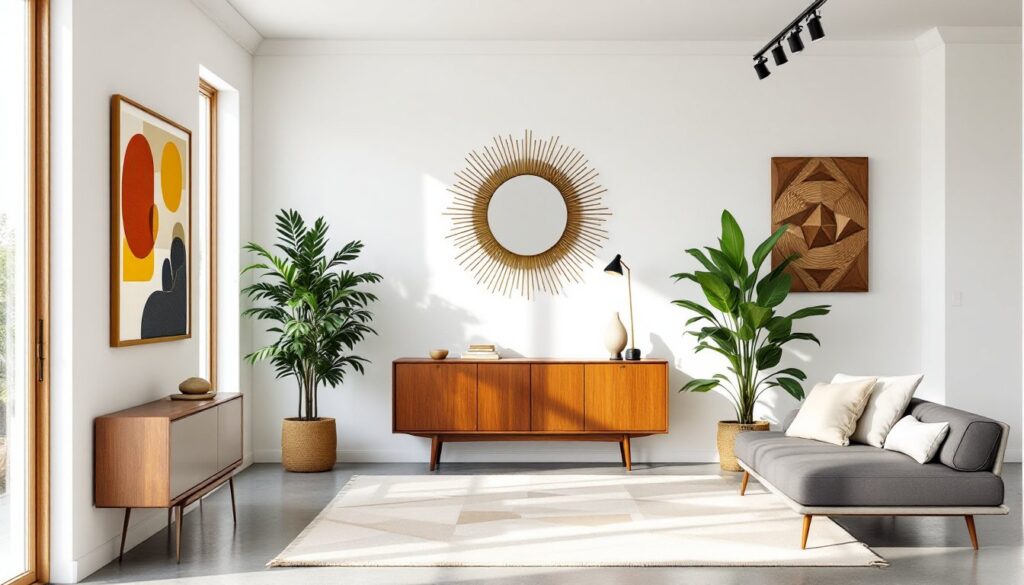
Abstract art became synonymous with mid century interiors, partly because it complemented the era’s architectural minimalism. Look for screen prints and lithographs featuring bold color blocks, organic shapes, or geometric patterns. Artists like Alexander Girard created textile designs that translate beautifully to framed wall art.
When selecting prints, pay attention to framing. Period-appropriate frames use slim profiles in walnut, teak, or black-painted wood, typically ½” to 1″ wide with minimal ornamentation. Modern reproductions often come in overly thick or distressed frames that undermine the clean aesthetic. Mat boards, if used, should be simple and proportional, usually in off-white or a color pulled from the artwork itself.
Triptychs and diptychs (three-panel or two-panel arrangements) were popular for creating horizontal visual flow, especially above low-slung sofas characteristic of the era. Spacing between panels should be consistent, typically 2″ to 4″ apart, and the arrangement should relate to the furniture grouping below it, not float randomly on the wall.
Sunburst Mirrors and Sculptural Wall Art
The sunburst mirror became an icon of mid century design, appearing in countless living rooms and entryways. Authentic versions feature metal rays (often brass, gold-tone, or black-painted steel) radiating from a central convex or flat mirror. Sizes range from petite 12″ diameter accent pieces to dramatic 36″+ statement mirrors.
When hanging a sunburst mirror, treat it as a focal point. It works well centered above a console table, credenza, or mantel, but avoid clustering it with too many competing elements. The piece already has inherent visual energy: give it breathing room.
Other sculptural wall art includes wood relief panels (think carved geometric patterns in walnut or teak), metal wall sculptures with abstract or nature-inspired forms, and ceramic tile compositions. Companies like Design Milk frequently feature contemporary artisans creating pieces that honor mid century principles while bringing fresh perspectives to the style. When mounting heavy sculptural pieces, use appropriate wall anchors, toggle bolts for drywall or screws into studs if the piece exceeds 10 pounds. Mid century homes often used 16″ on-center stud spacing, so measure carefully and use a stud finder.
How to Style Mid Century Modern Wall Decor in Your Home
Styling mid century wall decor requires restraint and intentional placement. Start by identifying anchor points, the sofa, credenza, or dining area, and build from there. A common mistake is hanging art too high: the center of a piece should sit at 57″ to 60″ from the floor, which aligns with average eye level. Above furniture, leave 6″ to 8″ of clearance between the furniture top and the bottom of the frame.
Gallery walls can work in a mid century context but require careful curation. Stick to a consistent color palette and frame style, arranging pieces in a grid or structured asymmetrical layout rather than a random salon-style hang. Plan the arrangement on the floor first, then transfer measurements to the wall using painter’s tape as a guide.
Balance is critical. If one wall features a large sculptural piece, the opposite wall might need only a simple print or nothing at all. Mid century interiors often used modern home design principles that emphasized negative space as much as filled space. The wall itself becomes part of the composition.
Lighting matters more than many DIYers realize. Picture lights or adjustable track lighting can highlight texture in wood carvings or create dramatic shadows with sculptural pieces. For renters or those avoiding electrical work, battery-operated picture lights have improved significantly and provide a warm 2700K to 3000K color temperature that complements mid century palettes.
DIY Mid Century Modern Wall Decor Projects
Creating custom mid century wall decor offers both cost savings and personalization. A straightforward project involves building a wood slat wall panel using 1×2 or 1×3 boards in walnut or poplar (stained to match mid century wood tones). Rip boards to consistent widths on a table saw, sand to 220-grit smoothness, and mount them vertically or horizontally with varying depths to create dimensional interest.
For mounting, use construction adhesive and finish nailers (18-gauge brad nails work well for 1× material). Pre-finish the wood with Danish oil or tung oil to enhance grain without adding a plastic sheen. Unlike many earlier decor trends, mid century design celebrates the natural wood finish rather than heavy lacquers.
Another accessible project is creating geometric canvas art using painter’s tape to mask off sections and acrylic paint in period-appropriate colors. The key is confidence in your composition, mid century abstract art often features bold, simple shapes rather than intricate detail. Use a level and ruler to ensure crisp lines, and remove tape while paint is slightly tacky (not fully dry) to avoid pulling up dried paint.
Sunburst mirrors can be DIYed using wooden dowels or bamboo skewers radiating from a small round mirror (available at craft stores). Cut dowels to graduated lengths, drill pilot holes in a plywood backing, and insert dowels with wood glue. Finish with gold spray paint or leave natural. This project takes patience, plan on 30 to 60 dowels depending on desired fullness.
Safety note: Always wear eye protection and dust masks when cutting and sanding wood. Work in a well-ventilated area when using finishes or adhesives, and follow manufacturer’s flash-off times before hanging.
Where to Find Authentic and Affordable Mid Century Modern Wall Pieces
Sourcing authentic mid century wall decor requires patience and a multi-channel approach. Estate sales and auctions often yield legitimate period pieces, especially in areas with mid century housing stock (California, Florida, parts of the Midwest). Arrive early and bring measurements, it’s frustrating to score a perfect piece only to discover it won’t fit the intended wall.
Online marketplaces like Chairish, 1stDibs, and even Facebook Marketplace turn up finds, but authenticate carefully. Learn to spot reproduction clues: overly perfect condition, modern hardware, or suspiciously low prices on “authentic” designer pieces. Platforms like Decoist showcase current interpretations that honor mid century aesthetics without the vintage price tag.
For affordable options, check architectural salvage yards for wood panels, room dividers that can be wall-mounted, or industrial elements that align with mid century’s honest-materials philosophy. Big-box retailers now carry mid century-inspired decor, though quality varies. Inspect joints, finishes, and materials in person when possible.
Reproductions and licensed reissues from companies that maintain original molds or patterns offer another route. These cost more than mass-market knockoffs but deliver authentic proportions and materials. When buying vintage, factor in restoration costs, refinishing a teak panel or re-silvering a mirror adds to the total investment.
Budget realistically. A genuine period sunburst mirror might run $200 to $800 depending on size and condition, while quality reproductions start around $150. Prints can be found for under $100 framed at vintage shops, but museum-quality pieces from known artists command significantly more. Mix investment pieces with DIY projects and affordable finds to build a cohesive look without overspending.