
Table of Contents
ToggleThe master bedroom should feel like a retreat, somewhere you want to be at the end of a long day. But too many people focus on bedding and furniture while leaving the walls bare or slapping up a few random frames. Wall decor sets the tone, anchors the design, and can make a room feel cohesive or chaotic. Whether you’re working with a blank canvas or fixing mistakes from a previous decor phase, the right approach to your bedroom walls makes all the difference without requiring a full renovation.
Key Takeaways
- Master bedroom wall decor establishes the room’s visual foundation and transforms bare walls into a cohesive, finished space that reflects your personal style.
- Choose a unified style direction—modern minimalist, farmhouse, bohemian, or traditional—and limit yourself to 2–3 accent colors to create visual rhythm and avoid a chaotic appearance.
- Gallery walls require careful planning with odd-numbered groupings, consistent 2–3 inch spacing, and a central anchor piece at 57–60 inches from the floor for balanced results.
- A single oversized art piece (40×60 inches or larger) spanning two-thirds of your bed width makes an impactful statement and works especially well in minimalist bedrooms.
- DIY wall decor projects like floating shelves, framed fabric panels, and wood plank accent walls let you personalize your space affordably while maintaining design control.
- Proper hanging height, secure mounting with studs or heavy-duty anchors, and a bubble level ensure your wall decor looks polished and prevents damage to drywall or plaster.
Why Wall Decor Matters in Your Master Bedroom
Walls occupy the most visual real estate in any room, yet they’re often the last thing homeowners address. In a master bedroom, bare walls create a hollow, unfinished feeling, even if the furniture is high-quality. Wall decor fills vertical space, adds texture and color, and can even influence how restful the room feels.
From a design perspective, walls serve as the backdrop for everything else. The right pieces pull together bedding, rugs, and accent furniture into a unified look. Poor choices, or no choices, leave the room feeling disjointed.
Wall treatments also affect perceived room size. Dark accent walls can make tall ceilings feel cozier, while light-toned art and mirrors reflect light in smaller spaces. If you’re dealing with awkward proportions (long narrow rooms, low ceilings), strategic wall decor can rebalance the space without structural changes.
Finally, the master bedroom is personal. Unlike living rooms or kitchens where guest opinions matter, this is where individual taste should lead. Wall decor is one of the easiest ways to inject personality without permanent alterations, no paint, no demo, just hanging hardware and a level.
Choosing a Cohesive Style for Your Bedroom Walls
Before buying or building anything, establish a clear style direction. Mixing styles works if there’s a unifying thread, color palette, frame finish, or subject matter. Without that anchor, even expensive pieces look like yard sale leftovers.
Start with existing elements: wall color, bedding patterns, and furniture finish. If the room has cool-toned grays and white trim, warm rustic wood pieces will clash unless you’re intentionally bridging styles. Many design experts on platforms like MyDomaine emphasize selecting a cohesive color story before adding decorative elements.
Common bedroom wall styles include:
- Modern minimalist: Clean lines, monochrome or muted palettes, oversized single pieces rather than clusters
- Farmhouse/rustic: Reclaimed wood accents, vintage finds, neutral tones with texture (woven pieces, metal signs)
- Bohemian: Layered textiles (macramé, tapestries), global prints, mixed metals and natural materials
- Traditional/classic: Symmetrical arrangements, ornate frames, landscapes or portraits in warm tones
- Industrial: Metal art, exposed brick or faux brick panels, black-and-white photography
Once you pick a lane, limit yourself to two or three accent colors that appear in multiple pieces. This creates visual rhythm. If your duvet has navy and blush accents, echo those tones in artwork, frames, or decorative shelving.
Avoid the temptation to fill every wall. Negative space, sections of bare wall, lets the eye rest and prevents the room from feeling cluttered. One well-placed statement piece often beats five mediocre ones.
Statement Wall Decor Ideas to Elevate Your Space
Statement pieces anchor a room and give the eye a focal point. In most master bedrooms, the wall behind the bed is prime real estate, but don’t ignore side walls, especially in larger rooms where the bed wall alone won’t carry the design.
Gallery Walls and Photo Displays
Gallery walls are popular because they’re flexible and scalable. Done right, they feel curated. Done wrong, they look like a junk drawer exploded.
Key guidelines:
- Plan the layout on the floor first. Use painter’s tape on the wall to mark frame outlines before driving a single nail. Measure twice, hang once.
- Stick to odd numbers. Groups of 3, 5, or 7 pieces feel more balanced than even numbers.
- Maintain consistent spacing. 2 to 3 inches between frames is standard. Use a ruler or cardboard spacer to keep gaps uniform.
- Mix frame sizes but keep finishes consistent. All black frames, all natural wood, or all white, mixing gold, silver, and black in one gallery usually looks chaotic unless you’re going full eclectic.
- Anchor with a central piece. Start with the largest frame at eye level (roughly 57 to 60 inches from the floor to the center of the piece) and build outward.
For photo displays, print quality matters. Cheap drugstore prints fade and look washed out next to real artwork. If you’re printing family photos, use a professional print service or high-quality home printer on heavyweight matte or luster paper.
Hardware tip: For lightweight frames (under 10 lbs), adhesive picture-hanging strips work and won’t damage drywall. Heavier frames need wall anchors or screws into studs. Don’t trust a single finish nail for anything over 5 lbs, it will sag or fall, especially on drywall.
Large-Scale Art and Oversized Pieces
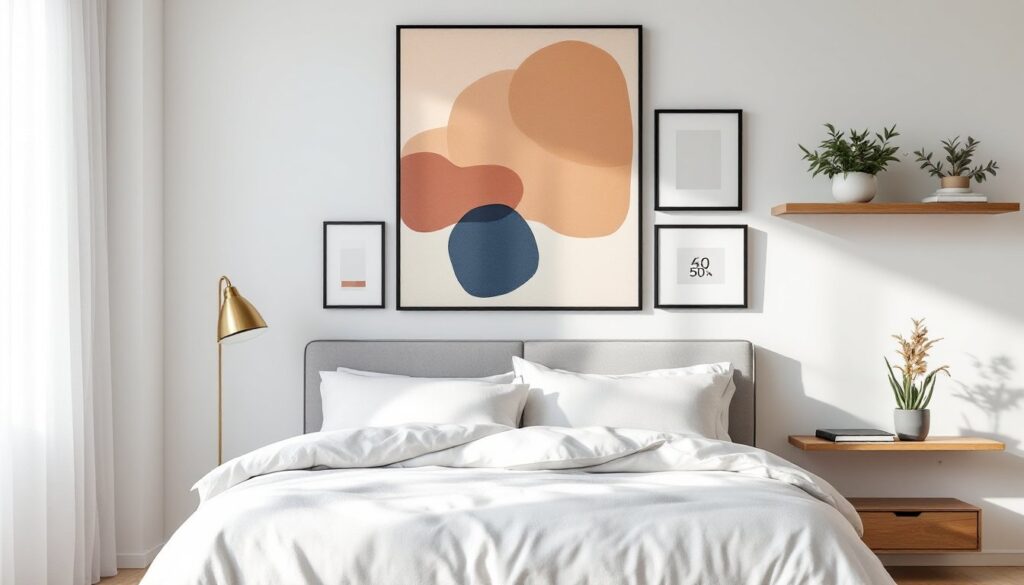
One oversized piece (typically 40×60 inches or larger) makes a bold statement without the fuss of arranging multiple frames. This works especially well in modern or minimalist bedrooms where simplicity is the goal.
When selecting large art, proportion is critical. The piece should span two-thirds to three-quarters the width of the bed for visual balance. A tiny 24×36 canvas over a king bed looks like an afterthought.
Material options:
- Canvas prints: Lightweight, easy to hang, available in custom sizes. Opt for gallery-wrapped edges (image wraps around the sides) to skip framing.
- Framed prints or posters: Adds formality. Black aluminum or natural wood frames suit most bedroom styles.
- Metal or acrylic prints: Modern, durable, and reflective, works well in contemporary spaces but can feel cold in traditional rooms.
- Tapestries or textile art: Softens acoustics, adds warmth. Hang with a curtain rod and clips or a wooden dowel and leather straps for a boho look.
Several bedroom wall decor showcases, including those on Decoist, highlight how oversized pieces create instant impact and simplify the design process.
Hanging hardware for heavy art:
For pieces over 30 lbs, use heavy-duty picture hangers rated for the weight or install a French cleat system, a beveled mounting strip that locks into a matching wall bracket. This distributes weight evenly and won’t sag over time. Always locate studs for anything over 50 lbs.
Budget-Friendly DIY Wall Decor Projects
Custom or high-end art isn’t the only option. DIY projects let homeowners personalize their space and save money, assuming you’re realistic about skill level and time investment.
1. DIY Floating Shelves
Floating shelves add dimension and let you rotate decor seasonally. Use 1×6 or 1×8 pine boards (actual dimensions: 3/4″ × 5-1/2″ or 3/4″ × 7-1/4″) cut to length. Finish with stain or paint, then mount with heavy-duty floating shelf brackets screwed into studs. Load capacity depends on bracket quality and stud placement, expect 20 to 30 lbs per bracket for standard residential studs.
Safety note: Always wear safety goggles when cutting lumber and a dust mask when sanding or staining.
2. Framed Fabric or Wallpaper Panels
Buy remnant fabric or peel-and-stick wallpaper samples (often available cheap or free from decor stores). Stretch fabric over foam core board or 1/2-inch plywood, then frame in inexpensive poster frames (IKEA, Michaels, or Hobby Lobby with coupons). This works for renters who can’t paint or wallpaper permanently.
3. Wood Plank Accent Wall
A full shiplap or board-and-batten accent wall is a weekend project for most DIYers. Use 1×4 or 1×6 pine boards (cheap and paintable) or tongue-and-groove planks for a tighter fit. Install horizontally over existing drywall with construction adhesive and finish nails. Paint in a contrasting or tonal color to the rest of the room.
Tool requirements: Miter saw (for clean cuts), nail gun (a brad nailer works for thin boards), stud finder, and level. A circular saw works if you don’t have a miter saw, but expect rougher edges that need sanding.
Cost estimate: Materials run $100 to $300 for a typical 10×12-foot accent wall, depending on lumber grade and regional pricing.
4. Large-Scale DIY Canvas Art
Buy blank stretched canvases (24×36 or larger) and acrylic paint. Abstract geometric designs (stripes, color blocking, simple shapes) require minimal artistic skill. Tape off sections with painter’s tape, paint, and peel. Seal with a clear acrylic sealer spray to prevent chipping.
If painting isn’t your thing, print oversized digital files (free from sites like Unsplash) at a local print shop on poster paper, then mount to foam core and frame.
Placement and Hanging Tips for Perfect Results
Even great decor looks amateurish if hung poorly. Proper placement and secure mounting make all the difference.
Height guidelines:
- Single piece over the bed: Center the piece horizontally. The bottom edge should sit 6 to 10 inches above the headboard or mattress if there’s no headboard.
- Gallery wall or multiple pieces: Treat the entire grouping as one unit. The center of the grouping should be 57 to 60 inches from the floor (standard gallery height).
- Art on open walls (not over furniture): Center at 57 to 60 inches from the floor to the center of the piece.
Spacing from furniture:
Leave 4 to 8 inches between the top of a headboard or dresser and the bottom of the art. Too much space disconnects the piece from the furniture: too little feels cramped.
Leveling:
Don’t eyeball it. Use a bubble level or laser level. For gallery walls, mark a horizontal baseline with painter’s tape and measure all pieces from that line. Small level errors compound when you’re hanging multiple frames.
Finding studs:
Use a stud finder to locate framing studs (typically 16 inches on center in modern construction, sometimes 24 inches in older homes). For lightweight pieces, drywall anchors work, but anything over 15 lbs should hit a stud or use toggle bolts rated for the weight.
Hanging hardware:
- Picture-hanging wire: Attach to frame D-rings, then hang from a single hook. Allows minor adjustments but can tilt if not tensioned correctly.
- Sawtooth hangers: Good for lightweight frames. Sits flush but offers no adjustment.
- French cleats: Best for heavy or oversized art. Extremely secure and allows easy removal for cleaning or rearranging.
If you’re uncertain about hardware or dealing with plaster walls (common in older homes), consult a handyman. Pulling chunks of plaster out of the wall costs more than the $50 service call.
For more innovative approaches to master bedroom walls, including textured panels and accent lighting, resources like Homify’s master bedroom wall ideas offer fresh inspiration.
Final tip: Step back frequently. What looks centered up close may be off when viewed from the doorway or bed. Take photos with your phone, the camera often reveals alignment issues your eye misses in person.