
Table of Contents
ToggleMost homeowners treat their laundry room like a functional closet, four blank walls, a washer, a dryer, and nothing else. But here’s the thing: if it’s a room you’re walking into multiple times a week, why not make it a space you actually enjoy being in? Good wall decor isn’t just about aesthetics. In a laundry room, it’s about combining smart storage solutions, visual interest, and a bit of personality to turn a chore zone into a room that feels intentional. Whether working with a cramped closet or a full-sized utility room, a few strategic updates to the walls can make all the difference.
Key Takeaways
- Strategic laundry room wall decor combines functionality with aesthetics, transforming a utility space into an enjoyable room you’ll actually want to spend time in.
- Floating shelves, pegboards, and hook systems serve dual purposes by providing organized storage for supplies while freeing up valuable floor space in compact laundry areas.
- Peel-and-stick wallpaper and removable wall decals offer low-commitment ways to add personality and visual interest to laundry room walls without permanent changes.
- Framed prints, canvas art, and laundry-themed typography bring color and character to otherwise appliance-dominated spaces while maintaining a cohesive design with the rest of your home.
- Laundry rooms are ideal low-risk environments to test bolder design choices like accent colors or wallpaper patterns before committing to them in high-traffic areas.
Why Your Laundry Room Deserves Decorative Attention
Laundry rooms take a beating. They’re exposed to heat, humidity, detergent spills, and lint buildup, and they’re often shoved into basements or tucked behind bifold doors without a second thought. But ignoring the walls in this space is a missed opportunity.
First, wall decor helps define the room’s function. Open shelving, pegboards, and labeled storage make it easier to keep supplies organized and within arm’s reach. Second, it improves the experience of doing laundry. A well-decorated wall can lift the mood in a space that’s otherwise purely utilitarian. Third, if the laundry room is visible from other parts of the home, common in open-concept layouts or homes with main-floor laundry, the decor contributes to the overall aesthetic continuity of the house.
From a practical standpoint, many wall decor upgrades double as improvements to room functionality. Installing a drying rack, adding hooks for garment bags, or mounting a folding station all enhance workflow while keeping the space visually tidy. And because laundry rooms are typically small, wall-mounted solutions free up limited floor space.
Finally, laundry rooms are low-stakes testing grounds for bolder design choices. Want to try removable wallpaper, a bright accent color, or floating shelves? This is the room to do it. Mistakes are cheaper to fix, and the smaller square footage means less material cost and faster project timelines.
Functional Wall Decor That Combines Style and Storage
The best laundry room wall decor serves double duty: it looks good and it works hard. Storage-focused solutions keep the counters clear, reduce clutter, and make supplies easier to locate mid-cycle.
Floating Shelves and Open Rack Systems
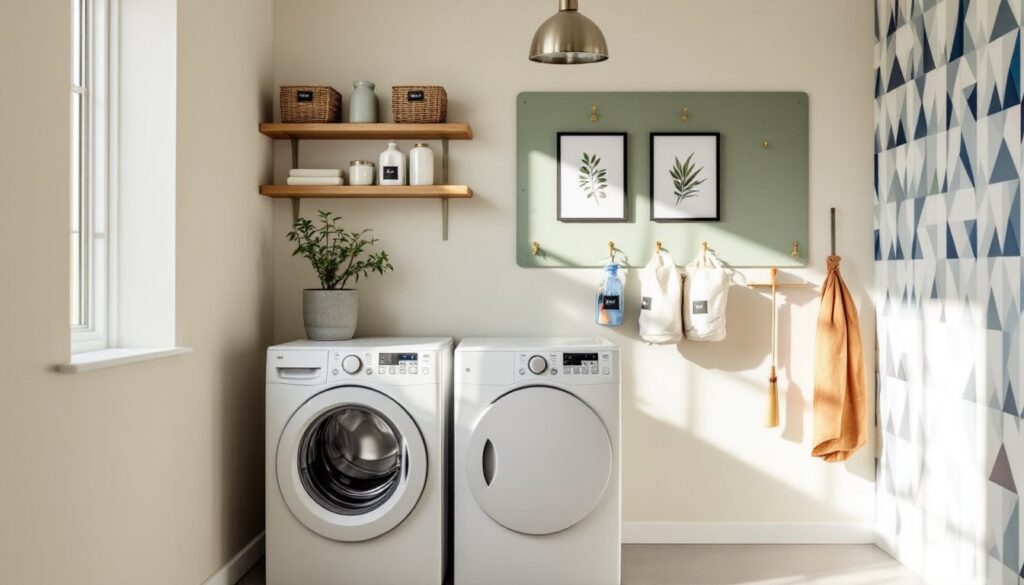
Floating shelves are one of the simplest, most versatile upgrades for laundry room walls. They’re available in wood, metal, and composite materials, and can be installed in an afternoon with basic tools: a drill, level, stud finder, and wood screws or heavy-duty wall anchors rated for the load.
For laundry rooms, choose shelves that are at least 10 to 12 inches deep to accommodate detergent bottles, fabric softener jugs, and stain removers. Mount them above the washer and dryer, or along an adjacent wall if top clearance is limited. Staining or painting the shelves to match trim or cabinetry creates a cohesive look.
Open rack systems, like wire shelving or industrial pipe racks, work well in utilitarian spaces where a polished look isn’t the priority. Wire racks from brands like ClosetMaid or Rubbermaid are adjustable and can handle heavy loads, but installation requires locating wall studs for secure mounting. Expect each bracket to hold 50 to 100 pounds when anchored properly into studs: drywall anchors alone won’t support heavy detergent stockpiles.
When styling open shelves, use matching baskets or bins to corral smaller items like dryer sheets, stain sticks, and lint rollers. Label bins with a label maker or adhesive tags, it’s not just for looks: it keeps everyone in the household from rummaging.
Pegboards and Hook Walls for Supplies
Pegboards are underrated champions of laundry room organization. A ¼-inch pegboard panel, mounted with spacers to allow peg insertion, turns a blank wall into a customizable grid for hooks, baskets, and small shelves. They’re sold in 2×4-foot or 4×8-foot sheets at most home centers, and they can be cut to size with a circular saw or jigsaw.
Installation is straightforward: locate studs, attach 1×2 furring strips horizontally as spacers, then screw the pegboard into the strips. Paint the pegboard before mounting to match the room’s color scheme, white, gray, or even a bold accent color work well. Hooks and accessories are interchangeable, so the layout can evolve as storage needs change.
Pegboards are ideal for hanging items like measuring cups, spray bottles, brushes, and mesh laundry bags. For heavier tools, irons, steamers, or handheld vacuums, use locking pegboard hooks or double-prong metal hooks rated for the weight.
Alternatively, a hook wall (individual hooks screwed directly into studs or blocking) offers a cleaner look without the grid pattern. Decorative hooks in brass, matte black, or brushed nickel add a design element while holding items like drying racks, reusable shopping bags, or the ironing board. Space hooks 12 to 16 inches apart to avoid crowding.
If the laundry room doubles as a mudroom, consider adding a row of coat hooks near the door for jackets, hats, or dog leashes. This keeps high-traffic items off the floor and out of the way. Homeowners looking for budget home makeovers often start with pegboards and open shelving in utility spaces, they deliver immediate visual and functional improvement without requiring a full renovation.
Artistic and Visual Elements to Brighten the Space
Once the functional elements are in place, it’s time to add personality. Artwork, wallpaper, and typography bring color and character to a room that’s otherwise dominated by appliances and cabinets.
Framed Prints, Canvas Art, and Laundry-Themed Typography
Framed prints are the easiest way to add visual interest to laundry room walls. Simple black or white frames with matte board keep the focus on the art, and they’re available in standard sizes (8×10, 11×14, 16×20) at big-box stores or online.
For subject matter, consider botanical prints, abstract patterns, or even vintage laundry advertisements. Humor works here, too, typographic prints with sayings like “Laundry Today or Naked Tomorrow” or “Loads of Fun” are popular, though they can veer into cheesy territory if overused. Balance cheeky text with more refined pieces to avoid a craft-fair aesthetic.
Canvas prints offer a frameless, modern alternative. They’re lightweight and can be hung with simple sawtooth hangers or Command strips if the wall can’t be drilled (common in rentals). Choose prints that tie into the home’s broader color palette, soft blues, greens, or neutrals usually work well in laundry spaces.
If the laundry room has upper cabinets or shelving, lean smaller framed prints against the wall rather than hanging them. This creates a casual, layered look and makes swapping artwork easier.
For those seeking more modern interior design inspiration, mixing matte-finish frames with simple line art or geometric prints keeps the space feeling current without overwhelming a small room.
Accent Wallpaper and Removable Wall Decals
Accent wallpaper transforms a laundry room faster than paint, and it works especially well on a single feature wall, behind open shelving, above a folding counter, or along the wall facing the door.
Peel-and-stick wallpaper is ideal for DIYers. It’s repositionable during installation, doesn’t require paste, and removes cleanly, critical for renters or anyone planning to change the look down the line. Patterns like subway tile, faux shiplap, small-scale florals, or geometric grids add texture without overwhelming a compact space. Avoid large, busy patterns in small laundry rooms: they make the walls feel closer.
Before applying wallpaper, clean and dry the wall thoroughly. Grease, dust, or moisture will prevent proper adhesion. Use a level and measuring tape to align the first strip, if it’s crooked, every subsequent strip will be off. Smooth out bubbles with a plastic smoothing tool or credit card as you go.
Traditional paste wallpaper offers more pattern variety and durability, but it’s a bigger commitment. Installation requires a wallpaper brush, seam roller, and utility knife, and removal later will involve a steamer and scraper. In high-humidity laundry rooms, opt for vinyl or vinyl-coated wallpaper, which resists moisture better than paper-only types.
Removable wall decals are the low-commitment option. Vinyl decals in botanical shapes, abstract forms, or simple line art can be applied in minutes and peeled off without residue. They’re best used sparingly, one or two decals on a neutral wall, rather than covering every surface.
Decals work particularly well around light switches, above door frames, or in awkward corners where framed art won’t fit. They’re also a smart choice for DIY decor projects in rental properties, where permanent changes aren’t allowed.
Safety note: If installing wallpaper or decals near electrical outlets or switches, turn off power at the breaker before working. Use a utility knife to trim around outlet covers carefully, don’t cover openings or interfere with wall plates.
Combining functional and artistic wall decor creates a laundry room that’s both efficient and enjoyable. Floating shelves keep detergent within reach, pegboards organize tools and supplies, and framed prints or wallpaper add the personality that turns a utility space into a real room. The result? A laundry room that doesn’t just work, it works well, and looks good doing it.