
Table of Contents
ToggleHello Kitty isn’t just for kids anymore. The iconic Sanrio character has grown up with millennials and Gen Z, popping up everywhere from high-end collaborations to DIY home projects. Whether someone’s going for a full nostalgia vibe or just wants a playful accent wall, Hello Kitty wall decor offers surprising versatility. The challenge? Making it look intentional rather than like a child’s bedroom exploded. This guide covers practical options, hands-on projects, and styling strategies that work for adults who still love that little white cat.
Key Takeaways
- Hello Kitty wall decor has evolved from childish aesthetics to a curated design choice for adults, blending minimalist character design with modern, contemporary interiors.
- Vinyl wall decals offer the easiest entry point for Hello Kitty wall decor, lasting 3–5 years without damaging surfaces, making them ideal for renters and those seeking temporary options.
- Apply the 60-30-10 design rule—60% neutral base, 30% secondary color, 10% accent—to keep Hello Kitty wall decor intentional and prevent spaces from appearing juvenile.
- Mix Hello Kitty prints with sophisticated elements like mid-century furniture, chunky wood frames, and quality textiles to signal design intentionality and mature style.
- DIY Hello Kitty wall art projects like painted canvas sets and stenciled accent walls deliver custom impact at $30–80 in materials, while official retailers and Etsy offer licensed options ranging from $10–200+.
Why Hello Kitty Wall Decor Is Having a Nostalgic Comeback
The surge in Hello Kitty decor tracks directly with millennial homeownership and the rise of what design experts call “kidcore”, a deliberate embrace of childhood aesthetics in adult spaces. Unlike previous waves of character-based decor, today’s approach focuses on curated nostalgia rather than wall-to-wall branding.
Several factors drive this trend. First, Hello Kitty’s minimalist design, a simple line drawing with no mouth, translates surprisingly well into modern, graphic-forward spaces. Second, Sanrio has leaned into collaborations with contemporary artists and brands, elevating the character beyond its original positioning. Third, social media platforms favor visually distinctive spaces, and a well-executed Hello Kitty accent wall delivers instant personality.
The 2026 iteration differs from earlier versions. Rather than saturated primary colors, current interpretations lean toward pastels, monochrome palettes, and vintage-inspired treatments. Homeowners are mixing Hello Kitty elements with mid-century furniture, Japandi aesthetics, and maximalist gallery walls. The key shift: treating the character as a design motif rather than the room’s entire identity.
Types of Hello Kitty Wall Decor for Every Room
Wall Decals and Stickers
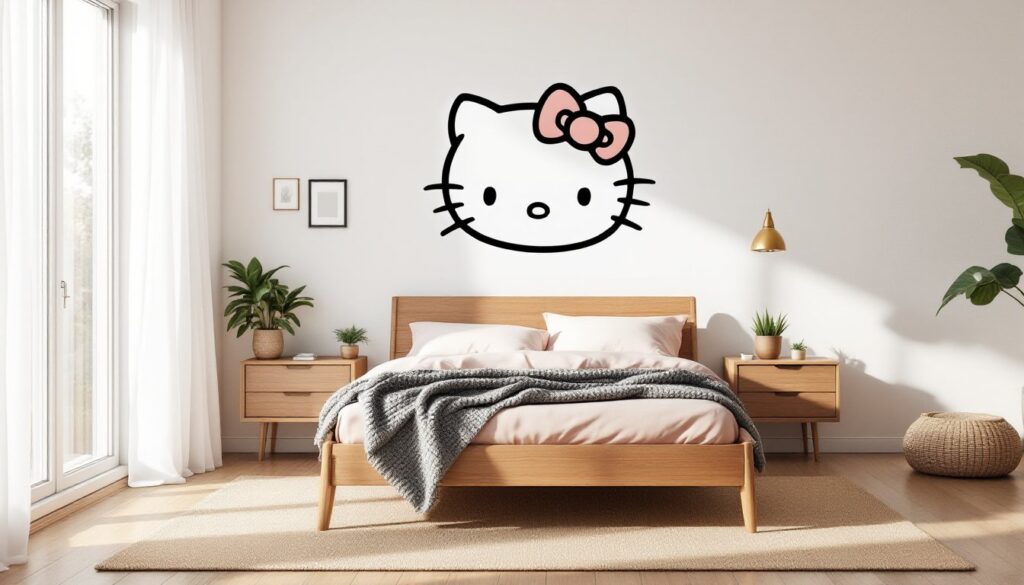
Vinyl wall decals offer the easiest entry point. They apply directly to painted drywall, require no nails or hardware, and remove without damaging the surface, critical for renters or anyone who changes their mind frequently. Quality decals use matte or semi-gloss vinyl that won’t yellow under UV exposure.
Application basics: Clean the wall with isopropyl alcohol to remove dust and oils. Use a level and painter’s tape to mark placement before committing. For large decals, the hinge method works best, stick the center first, then work outward to avoid bubbles. A plastic squeegee (a credit card works in a pinch) helps eliminate air pockets.
Decals work particularly well on accent walls behind beds or desks. Avoid textured surfaces like knockdown or orange peel finishes, where adhesion fails within months. Most vinyl decals last 3-5 years before edges start lifting, making them a semi-permanent solution.
Framed Prints and Posters
Framed artwork gives more flexibility and a polished look. Options range from vintage Sanrio promotional posters to contemporary artist interpretations. When selecting frames, consider the room’s existing trim and furniture. Black frames with white mats suit modern spaces, while natural wood frames complement bohemian or Scandinavian interiors.
Standard poster sizes, 11×17″, 18×24″, or 24×36″, fit readily available frames from big-box stores. For gallery walls, mixing Hello Kitty prints with other artwork prevents the space from reading as juvenile. A common formula: one Hello Kitty piece for every two-to-three neutral or complementary prints.
Hanging hardware matters. For frames under 10 pounds, standard picture hangers with 20-30 lb capacity work fine on drywall. Heavier frames or plaster walls require anchors. The old “nail through the hanger hole” approach often leads to crooked frames, invest ten dollars in a small level and proper hangers.
DIY Hello Kitty Wall Art Projects You Can Make Today
Painted Canvas Set: A straightforward weekend project. Purchase pre-stretched 12×12″ or 16×20″ canvases (available at craft stores for $5-15 each). Use a projector or print-and-transfer method to outline the Hello Kitty silhouette. Acrylic paint works best, two coats minimum for solid coverage. Let each coat dry 2-4 hours. For a modern look, try a monochrome palette: white canvas, black outline, with one accent color for the bow.
Stenciled Accent Wall: This requires more commitment but delivers impact. Create a stencil from heavyweight Mylar sheets (available at office supply stores) or purchase laser-cut versions online. The stencil approach works for repeating patterns across an entire wall.
Materials needed:
• Stencil (either homemade or purchased)
• Low-tack painter’s tape (blue or green tape, never masking tape, which bleeds)
• Stencil brush or foam roller (4″ roller covers work well)
• Interior latex or acrylic paint in desired color
• Level and measuring tape
Process: Mark a grid on the wall using light pencil marks and a level. Secure the stencil with painter’s tape. Apply paint with a nearly dry brush or roller, excess paint causes bleed-under. Two thin coats beat one heavy coat. Work top to bottom to avoid smudging.
Wood Cutout Wall Hanging: For those with basic woodworking tools, Baltic birch plywood creates dimensional art. Trace or print the Hello Kitty outline onto 1/4″ or 1/2″ plywood. A jigsaw with a fine-tooth blade (10-12 TPI) cuts curves cleanly. Sand edges with 120-grit then 220-grit sandpaper. Finish with acrylic paint or wood stain. Mount using keyhole hangers routed into the back or French cleats for larger pieces.
Safety note: Always wear safety glasses when cutting, and a dust mask when sanding. Work in a ventilated area or outdoors.
Many home crafting projects follow similar patterns, prep work determines success more than artistic skill.
How to Style Hello Kitty Wall Decor Without Overwhelming Your Space
The difference between “intentional” and “college dorm” comes down to restraint and context. Start with the 60-30-10 rule: 60% neutral base, 30% secondary color, 10% accent (where Hello Kitty elements live). This prevents the space from reading as a shrine.
Color palette strategies matter significantly. Pastels (blush pink, mint, lavender) paired with white and natural wood create a softer aesthetic. For bolder approaches, pair Hello Kitty black-and-white graphics with one saturated accent, emerald green, navy, or terracotta. Avoid the trap of thinking everything must be pink just because the bow is.
Scale and placement: One large statement piece (a 36×48″ canvas or wall decal) anchors a room better than ten small scattered items. If using multiple pieces, cluster them in a defined zone, above a desk, behind a bed, or in a gallery wall arrangement. Spread randomly across multiple walls, the decor loses cohesion.
Mixing styles prevents childishness. Pair Hello Kitty prints with mid-century modern furniture, industrial lighting, or minimalist shelving. The contrast signals intentionality. Similarly, incorporating sophisticated interior design ideas alongside character-based decor creates balance that reads as curated rather than accidental.
Texture adds maturity. A Hello Kitty print in a chunky wood frame or behind museum glass carries more weight than a poster with thumbtacks. Pair wall art with grown-up textiles, linen curtains, wool throws, leather accents. The juxtaposition works.
Finally, know when to edit. If every surface carries Hello Kitty branding, the room loses visual breathing space. Leave negative space. Let walls show. The goal isn’t to showcase a collection, it’s to create a room that happens to include Hello Kitty as one deliberate design choice.
Where to Buy Hello Kitty Wall Decor in 2026
Official Sanrio retailers offer licensed products with quality control. The Sanrio online store ships directly and releases exclusive designs, though prices run higher than third-party sellers. BoxLunch and Hot Topic carry officially licensed wall art at mid-range prices, often with sales and clearance options.
Etsy dominates the handmade and vintage market. Search for “Hello Kitty wall art” to find everything from digital downloads (print-at-home for $3-8) to original paintings. Read seller reviews carefully, quality varies significantly. Look for shops with hundreds of sales and recent positive feedback. Many sellers offer custom sizing and color options.
For those seeking elevated room designs with Hello Kitty elements, some boutique design shops now carry artist collaborations that blend Sanrio characters with contemporary art styles.
Amazon and Walmart stock mass-market decals and posters, typically at the lowest price points ($10-30). Quality control becomes hit-or-miss. Check recent reviews for complaints about thin vinyl, poor adhesion, or faded printing.
Target occasionally runs limited Sanrio collaborations with better design curation than typical mass-market offerings. Their Opalhouse and Room Essentials lines sometimes incorporate Hello Kitty in more sophisticated executions.
For DIY materials, canvases, paints, stencil supplies, Michaels, Hobby Lobby, and Joann Fabrics run frequent 40-50% off coupons. Never pay full price at craft stores. Their websites list current promotions.
Local print shops can produce custom Hello Kitty wall art from digital files. Prices for a 24×36″ print on quality poster stock run $20-40. Canvas prints or mounted options cost more but last longer. This route works well for obscure vintage Sanrio artwork found online that isn’t available as commercial prints.
Budget expectations: Vinyl decals range $15-50 depending on size. Quality framed prints run $40-150. Custom artwork or larger installations can exceed $200. DIY projects typically cost $30-80 in materials, assuming basic tools are already owned.